Jo Boaler Getting to Know You

- View Larger Image
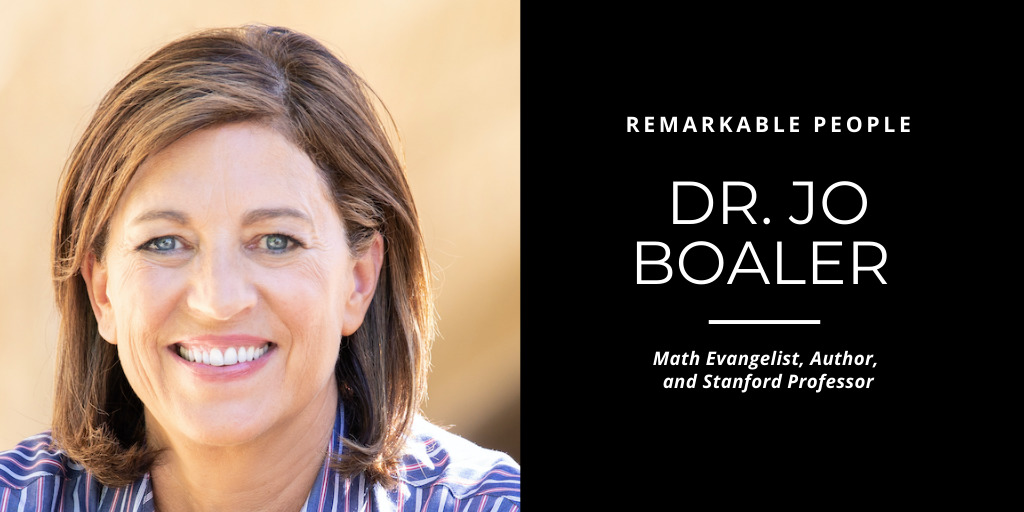
Dr. Jo Boaler
Dr. Jo Boaler is an evangelist. Evangelism comes from a Greek word significant "bringing the proficient news." The practiced news that she brings is that there is a better way to teach math.
Jo started her career equally a math teacher in secondary schools in London. Then she received a master's and Ph.D. in math education from Male monarch's College London.
She became an assistant professor of math education at Stanford and achieved a full professorship in 2006. She left Stanford to teach at Sussex University and then returned to Stanford in 2010.
She also co-founded a company called youcubed. This visitor sells mathematics teaching resource. Finally, she is the author of nine books. Her latest is chosen Limitless Heed: Larn, Lead, and Alive Without Barriers.
In essence, Jo'due south goal is to modernize the didactics of math. She believes in revamping the methods that take been around since the 1800s by removing rote memorization and timed tests.
Her methods make math more than relevant with creative, inter-connected, and information-science activities that involve a growth mindset. Forth the way, she did upset the condition quo of math pedagogy.
For example, in 2006 another Stanford professor named James Milgram accused her of scientific misconduct. Stanford officials investigated these allegations and concluded that they "do not have substance."
Listen to Dr. Jo Boaler on Remarkable People:
If you enjoyed this episode of the Remarkable People podcast, please head over to Apple tree Podcasts, leave a rating, write a review, and subscribe. Thank you!
Join me for the Behind the Podcast show sponsored by my friends at Restream at 10 am PT. Brand sure to hit "fix reminder." 🔔
Text me at 1-831-609-0628 or click here to join my extended "ohana" (Hawaiian for family unit). The goal is to foster interaction nearly the things that are important to me and are hopefully important to you too! I'll be sending yous texts for new podcasts, live streams, and other sectional ohana content.
Please do me a favor and share this episode by texting or emailing it to a few people, I'yard trying to abound my podcast and this will help more people find information technology.
Not bad episode of my favorite podcast, Remarkable People. Click here to mind 🎧 Click To TweetTranscript of Guy Kawasaki's Remarkable People podcast with Jo Boaler
Guy Kawasaki: I'1000 Guy Kawasaki, and this is Remarkable People. This episode's guest is Dr. Jo Boaler. Jo is fundamentally an evangelist. Evangelism comes from a Greek word meaning bringing the proficient news. The good news that Joe brings is that in that location is a better way to teach math. Jo started her career as a math teacher in secondary schools in London.
Then she received a master'south and a PhD in math pedagogy from Kings College, London. She became an banana professor of math education at Stanford and achieved a full professorship in 2006. She left Stanford to teach at Sussex University and and then returned to Stanford in 2010.
She also co-founded a company called YouCubed. This company sells mathematics education resources.
Finally, she is the writer of nine books. Her latest is called Limitless Mind: Learn, Lead, and Live Without Barriers. In essence, Jo'south goal is to modernize the instruction of math. She believes in revamping the methods that have been effectually since the 1800'due south past removing rote memorization and timed tests.
Her methods make math more than relevant with creative interconnected and data-science activities that involve a growth mindset. Oh, forth the fashion, she upset the status quo of math teaching–You'll learn almost this shortly.
I'g Guy Kawasaki, and this is Remarkable People, and now here's the remarkable Jo Boaler.
Guy Kawasaki: Was there a teacher who changed your life?
Jo Boaler: I did have one maths teacher that kept me in maths, and here I am still in mathematics. And yes, she did change everything.
It was in the UK. I was nigh seventeen at the time. And prior to that, all my maths teachers, mainly they were men, they would lecture, we would re-create, so this adult female came along who, offset of all, allow us talk nearly maths, so that was incredible, and we got to discuss ideas.
I still remember her running in the room, panting, hiding behind the door and proverb, "Oh my God, the head teachers out there and I'1000 wearing earrings." So, she was a character.
Guy Kawasaki: What?! You lot couldn't wear earrings?
Jo Boaler: Oh, yes. There'southward a lot of rules in England about what you can wear in schoolhouse.
Guy Kawasaki: Wait…why couldn't a instructor wear earrings?
Jo Boaler: Skillful question. I don't know. But I–plain, that was a rule and she was breaking it so she really meant a lot to me. Actually, I got in touch with her final year out of the blue, later on decades, and we reconnected which was nice.
Guy Kawasaki: You should send her some earrings.
Jo Boaler: I should.
Guy Kawasaki: I wonder if she knows the impact of that story on you. That'south a great story.
Jo Boaler: I didn't think so. I shared with her other things that were very impactful. I didn't mention the earring part.
Guy Kawasaki: Oh, you lot got another impactful story you desire to share with us well-nigh her?
Jo Boaler: I don't retrieve so. To me, she changed maths for me. That was what was the biggest impact. Suddenly I saw it was a subject that you could have ideas about, not just a lot of facts that you had to reproduce.
And that was the start of something.
Guy Kawasaki: What is the purpose of learning math? Is it for applied use on a twenty-four hour period-to-day basis? Is it to shape immature minds to learn how to problem solve? Is it to prepare for the SAT?
Jo Boaler: Well, there'south answer I could give of what I would hope maths is in that location for, then at that place'southward the answer of the part mathematics plays in our society. On the latter point, I call up for almost people, it's all about how well and how quickly I can solve problems, whether I can exercise well on narrow tests.
And they don't meet mathematics outside of that. It'southward all nigh ranking and evaluating. And that is very distressing to me because maths tin be this beautiful, visual, creative subject, and it can certainly be very of import to people's lives in lots of different means, whether it's analyzing data, which we have everywhere at present, or just working out a pattern which unlocks a whole new industry in Silicon Valley.
So it'due south important, simply not in the fashion we teach it by and large.
Guy Kawasaki: Do you recall that the pandemic causing the lack of Saturday's is going to assist the state of affairs?
Jo Boaler: Quite possibly, yes, I mean, that is definitely i of the upsides of the pandemic is all of these colleges that no longer taking the Sat and hopefully they'll continue with that. And and so, I call back the pandemic has been sort of mixed in terms of its bear on on classrooms and teaching, only that is definitely i of the most positive outcomes I would say.
And these colleges maybe are having to figure out better assessments that actually appraise something valuable.
Guy Kawasaki: Do you think at that place's any correlation with an Saturday score and success in college or life?
Jo Boaler: I think people can tell you lot that the correlation is extremely low and it SAT scores practise not predict how well people practice in higher and even less predict how well they practise in life. So that'south one reason to not use them; They're just really bad at predicting anything nosotros care about.
Guy Kawasaki: Isn't the history of the Saturday that it was given to determine who would go to war and who wouldn't or it's something like that. It's zip to practice with how we use it today.
Jo Boaler: Hmm. Interesting. I–I don't know, but you know, nosotros know that it's hugely impacted past the wealth of families and how much individual tutoring–I mean, the whole tutoring manufacture, for profit tutoring companies, I'm sure they're actually worried that the Sabbatum is going to get away. Yeah, So I mean, there's and then many bad things almost it and something I intendance nigh is information technology doesn't measure creative mathematical thinking at all.
Guy Kawasaki: I would make the case that many people would consider the phrase "creative mathematical thinking" an oxymoron. Only one way to solve a quadratic equation. There'due south simply ane manner to solve an algebra. And then, what's artistic in math?
Jo Boaler: I would say to those people, "come to YouCubed, our website, accept a wait at some of the tasks." Some of the nigh creative mathematics is actually representations of quadratic expressions. Quadratic is a manner of describing a function or a blueprint. So, one of the things I honey to do is share with people visual patterns and enquire them, "how exercise you see this?"
And they came upwards with all these unlike creative ways of seeing it and those creative ways lead to quadratic expressions that they're equivalent to each other. So, definitely nosotros can exist creative with maths. But I hold with you, well-nigh people that can't cannot fifty-fifty recollect of those words together, artistic and maths, because they've never experienced that. They've only experienced this narrow performance subject, sadly.
Guy Kawasaki: Can you lot specifically explain the utility of learning calculus? Because I learned calculus and I don't–I don't think I ever used it. Then, what's the logic there?
Jo Boaler: I can tell y'all that we're spearheading a movement at the moment with Steve Levitt who's an economist–very famous for writing for economics–to get data science, to be an alternative pathway in schools, an alternative to calculus. And I'm a big fan of that.
I think for some people calculus is useful. If you're going to be an engineer, great! Practise calculus. For the residual of the earth, data science would be much more useful, really relevant and engaging.
Then, I take a skillful friend, his name is Steve Strogatz. He'due south a mathematician at Cornell, and he just wrote a book, came out last year, called Infinite Powers about what is important about calculus. He tells all these stories near the people who invented it but also all of the ways information technology'southward important in the film industry, in medicine, and technology. And and then, it's a fascinating read, but he would say, I think, that it's not the calculus were teaching. The calculus in schools is driven by the AP exam back to the Higher Lath.
A lot of methods that kids don't really empathise. And then, I would be a fan of teaching people a dissimilar calculus. I'thousand also a fan of having different mathematical options–why do we push our kids to calculus? Maths is a broad bailiwick, and there are more interesting, more than engaging pathways that people tin take.
Guy Kawasaki: Would yous define Data Science for those of u.s.a. who are wondering what exactly yous and Steve Levitt are referring to?
Jo Boaler: And then, data science is–or data literacy–is the ability to sympathise and clarify data and create these amazing information visualizations that we're seeing everywhere now. And we remember the learning of data scientific discipline actually takes part in a process. Information technology'southward kind of inquiry procedure; starts with asking a question. Then, you have some that you're curious virtually, you inquire a question, you find some data that helps yous reply it, and yous do some work with that data, so yous need to communicate almost what you've discovered.
So, in that location'south a big storytelling part to it. So, it's this process of asking questions and developing pregnant and then communicating with information. That turns out to exist really engaging for people, actually interesting, and pretty of import to the earth right now.
Guy Kawasaki: I recollect very few people understand the difference between hateful, median, and mode, and those are very important. When you lot read an article in the Washington Post or the New York Times, and they put out a number at that place, you have got to empathise: is it mean, median, or way? And exercise you call up near people sympathize that?
Jo Boaler: I recollect for most people, they're taught them, all in ane go, and they learn a method or a procedure, and and then they forget and they tin't tell you what the deviation is between them. And so, once again, information technology's an example of something that's important, simply it'south taught in the incorrect way, and most people can't tell you as adults what those dissimilar measures mean to use "mean."
I'll merely give a piddling plug here: I adult an online class terminal summertime to help people larn about data science. In that location'south a fiddling drawing in it about hateful, mode, and median which involves my dog, Alfie, which nosotros made. And we try and show how to learn these in a way that is really meaningful for people. Pitiful about that.
Guy Kawasaki: That'southward good. That'south good. Give us the gist of how y'all think math should be taught.
Jo Boaler: Hmm. I would start by saying that nosotros have incredible neuroscience now that tells us about how our brains work with mathematics. And one of the fundamental messages I try and become out to learners that neuroscience tells us is that everybody can learn maths. And, in fact, we're developing and strengthening pathways all the time. Nosotros're not born with them.
So that'southward really important. And I think, however, yous teach maths, you lot need to give kids that message, that these are old ideas of, "I wasn't born with the right brain." Nosotros have to go rid of that. Merely as well, the neuroscientists tell us that when people engage with a maths problem, there are five different pathways in the brain that are activated.
Two of them are visual. So, we desire kids – people–thinking visually, it's actually important, only besides the best way to develop a mathematical brain is to accept these pathways be communicating with each other. And so that kind of brain communication happens when we experience maths in different ways. So, if I were to do a problem with numbers merely also describe that problem, that would cause a connection between two brain areas.
And if I was to build something to represent it, or move, or develop some music to represent it, these would all cause different areas of the encephalon to be activated. And then, the approach to maths that nosotros put out is one that'southward very multi-dimensional. We get kids to experience it in different ways.
It's besides very creative considering all of our issues are visual and, as people, how they see things, people observe them much more than interesting, and different students, different people, hordes of uncomplicated teachers who've been traumatized by the maths approach they had in school, love this approach to maths.
And and then, this is office of the reason we have a lot of people are coming to our site because we're really offering a very different version of mathematics.
Guy Kawasaki: These methods, are they not applicable to learning of whatever bailiwick or is this math specific?
Jo Boaler: Yeah, no, it'due south true that they are applicative to the learning of anything. I really work hard to get this message out around maths considering maths is the subject that needs this more annihilation. It's the almost narrowly taught, the most procedurally taught, but it is true that you want to be engaging these multiple ways with anything.
Other teachers, humanities teachers, have tended to engage kids in different ways over the years, having kids human action and write and do stories. But, maths has been and so narrow that it really needs to get this approach.
Guy Kawasaki: You cite Carol Dweck several times in your book and she is one of my heroes and I'll tell you…
Jo Boaler: Me too.
Guy Kawasaki: Yep! And, information technology's obvious why she would be a hero because of her writing, her bookish track record, and all that kind of stuff. I'll tell you a fiddling Ballad Dweck story that really only kind of cemented my whole aura and awe of her.
And then, believe information technology or non, she and I–this is in the days when we were even so traveling–we employ the aforementioned limousine driver. Then, this limousine driver would pick me upward, take me to the airport, pick her upward, take her to the airport. And he died a few years ago. Then, this was a small ceremony, a little community church in Palo Alto.
And this wasn't Mem Chu, Steve Jobs, 2,000 people, trunk guards, Sting coming and all that. This was a fiddling community church building in Palo Alto, and Carol Dweck and her married man came to the funeral of our mutual limo driver. And that really just said and then much to me.
Jo Boaler: That'south actually keen.
Guy Kawasaki: I dearest her mindset piece of work. So, now going downwardly the Carol Dweck path here, what are the negative consequences of being labeled "gifted"?
Jo Boaler: Many, actually, as information technology turns out, when nosotros praise young children until they're gifted and they're smart, what they hear in those moments is, "Great! I'k gifted. Great. I'g smart." Simply then later when they struggle or mess up on something, they commencement to call back, "Hmm, I'm not gifted. I'thousand not smart."
And in fact, some of Ballad's work has shown that when we praise kids, when they're doing a task and say, "Y'all are then smart," immediately after that, they will choose an easier task because they want to agree on to that label.
So, she and I both do a lot of work to try and eradicate education of those ideas and labels, just of course they're very embedded in an education system. We have a video on our website, which I really similar, where I decided to ask lots of Stanford undergrads about their experiences of beingness labeled "gifted," which of course they all have.
And each 1 of them steps to the mic and just talks about, "I was afraid to ask questions. I was agape to take a risk." It'south actually a powerful film. And then we get these fourth graders to come to the mic who were all in a schoolhouse that doesn't use those labels. And they're also really interesting to listen to, and they are quite clear that it's not good to praise people for beingness smart.
But they've never been praised for existence smart, and they have a wholly different outlook on their lives than these Stanford undergrads. And then yeah, in that location's so much damage to these fixed labels, just they're still very ordinarily used.
Guy Kawasaki: So instead of saying your child is "gifted" or "smart," what practise you praise them for?
Jo Boaler: And so, we tin can still praise our kids, but what we should praise them for is things they've done rather than things about them as a person. And so, it's fine to praise them and say, "That's fantastic work you've washed," "That'due south really lovely," "artistic," "not bad ideas," without saying that "y'all're smart" label.
Nosotros know as well that those labels are much more than readily practical to some people in the population–Men more women; White people more than people of color.
So, there's but a lot within those notions that nosotros need to work confronting.
Guy Kawasaki: Are there any limits or downsides to a growth mindset?
Jo Boaler: I would say that, there'due south been quite a lot of criticism of mindset. And to me…
Guy Kawasaki: You hateful Mindset, the volume or mindset the concept?
Jo Boaler: The theories, the concepts. There are people who effort and practice research to prove it doesn't work, merely this is what I think about that: to really have on mindset ideas, information technology'due south not just about maxim words to people. As an educator, you lot demand to infuse information technology through your teaching.
Then, yous can't say to kids, "You tin acquire anything and mistakes are really valuable" and "Lean into struggle," and then give them a time test where they're marked downwardly for whatsoever mistake they make and teach in a very narrow way so they cannot meet how they can achieve.
So, we detect that when mindset is infused into teaching, and my volume, 50imitless Mind, has lots of examples of that. It'southward transformative. But some people give kids mindset letters so everything goes on the aforementioned.
The teaching is the aforementioned; the testing is the same; and they don't find information technology makes much difference. The kids don't meliorate, and and then they publish those studies. And I call back that's where the critique of mindset comes. People will say, "you're asking in kids to modify without changing the system."
And our messaging is the opposite of that, our messaging is, "we demand to change the system. We need to alter pedagogy in schools to embed these messages in what we practise." And then, I tin see where that critique has come from. But I think that's people not really agreement how mindset works.
If you really talk to Carol and other people, they'll talk about how do you enact a mindset approach? Information technology'south not just saying words to kids and and then finding it doesn't do much.
Guy Kawasaki: If you're a mindset believer–a Dweck and Boaler believer–do yous say, "Okay, and so this is easy for yous, but I want to focus on what comes hard"? Or practise you lot say, "Run with your strengths"? Or practise yous say, "Minimize your…"?
Jo Boaler: Yeah, good question. It does plow out that nosotros run across certain students say, or children who seem to find things easier, and I think we have too much in the past said, "Okay that's your strength go with that." We can recognize people that accept strengths and weaknesses, but at that place's so much possibility to develop in those areas that people regard as weak, that we shouldn't really give that message.
Information technology used to exist believed that, "Okay, you're weak at that. You lot don't have the right kind of brain." Now we know you may be weak at that now and your brain may not be doing well in that area, simply you can develop it and change information technology." And so, I remember information technology does have implications for that bulletin.
I know when I've been presenting to adult audiences around my book, I've had a number of people from workplaces say, "Oh, we've always divided our employees into their strengths and weaknesses. Are you saying we should stop that and we tin can have people develop in other areas?" And I say that, "Aye, that is what I'thousand saying."
Guy Kawasaki: You could nearly make the case that, for college admissions, you should just accept your applicant pool and randomly select people.
Jo Boaler: Almost. Or select people on whether they have a growth mindset and whether they're willing to approach problems with flexibility and inventiveness instead of selecting people who have memorized—actually, that'south what we select on at the moment.
Guy Kawasaki: And, how would you test for that in a college app?
Jo Boaler: These are the actually large and important questions for our time. Nosotros know that in that location's different kinds of cognition is of import, creative, flexible mindset. How do you lot test for that big calibration? Because nobody'southward really developed that yet.
Certainly, yous can sit downwardly with people and see who has a growth mindset and measure for that, but tin you exercise that on a really big scale way? I remember you tin can, but I don't think many people are investing in trying to effigy that out.
Guy Kawasaki: If nosotros could just back up for 10 seconds at that place. So, you said it and then smoothly, you tin simply sit down with someone and tell if they take a growth mindset. Oh…how? I don't think it's that easy. How practise you do that?
Jo Boaler: In my ain work, when I teach classrooms of kids or when I work with people in the center that I atomic number 82, I run into. I certainly see people who accept a fixed mindset and I come across that when something difficult comes forth.
Information technology's really how practice people deal with situations where something goes wrong, or they fail, or they're struggling, that'due south when you see what kind of mindset they have. Doesn't actually come out when everything is going really well, but information technology comes out in those, more hard, times.
So, I estimate I would bring people in and give them something really difficult to practise.
Guy Kawasaki: And how would you distinguish if a person finds something really difficult or but not interesting?
Jo Boaler: If somebody approached a task that we designed by their–if their response to it was, "I'm not interested in this. What? Are we really going to jump into this?" That would be an interesting variable I would accept notation of besides. This reminds me, really, with a story I heard Carol tells once of how this whole mindset research started.
She said that she was interviewing immature children and giving them difficult tasks to do. And a lot of the kids were like, "Oh, that'due south difficult," and sort of turning abroad. And, this one boy came in and said, "Oh, I can't do this. Fantastic! I'thousand really excited to attempt and effigy it out," and she was really struck past the deviation.
And that was really what started her on this whole decades of research into mindset. I see that in my–the people I work with–my doctoral students, staff. I see that when something comes up that's difficult, or maybe we suddenly realized we need some new software, we need to acquire some new software to practise something.
And at that place are some of the people who will always say, "I'll larn that," "I'll practise that." "I'one thousand willing to take that on," and others who back off. I think in those moments, that's mindset that you see.
Guy Kawasaki: These are your doctoral students. Do they not know you well plenty to think that that's a impaired answer for yous?
Jo Boaler: Sometimes it takes a while.
Guy Kawasaki: Okay.
Jo Boaler: Maybe when they're leaving, they know that.
Guy Kawasaki: Send them over to the psych department. I read a very interesting role of the book well-nigh dust and Angela Duckworth. And yous point out, maybe problems or– problem is too potent a give-and-take, but you brought out some subtlety about this– who argues against grit, right? But yous talk almost the current communication of grit is you have to focus on something and just give it your all, and also, that it is a solo activity. And then, tin can you address those ii bug that grit believers similar me demand to be cognizant of?
Jo Boaler: Those are two problems, I call up with the whole notion of dust, certainly we can all hold that having somebody, I don't know, perhaps they want to be a professional athlete, they're really going to have to be gritty. I've lived around professional athletes, and they take to really focus on that and piece of work for it. Bang-up.
But the bug with that lens, I think, one is, it does suggest that this is an individual attribute that y'all develop, whereas almost people who are successful, including athletes, practice so as a part of lots of work with other people, teams, coaches, others. Merely the other problem I think, is specially when it's used in the evolution of young children.
If, you know, nosotros're communicating to these young people, "choose your passion, and be gritty and go for information technology," nobody knows what those kids are going to actually be fulfilled past, and we don't want them to choose one thing and go for information technology, really, at a young age or at whatsoever age in school. You have to exist really sure and have had a lot of life experiences to make decisions like that. Those are just kind of some cautions I estimate I have around information technology'due south overuse.
Guy Kawasaki: You would think if you asked children to pick something and focus on it and testify your grit, they would option the easiest matter, right? They wouldn't–it would be counterintuitive for them to think "I'1000 going to pick something that I suck at because…"
Jo Boaler: That I'chiliad non very good at. Aye.
Guy Kawasaki: …which might exist math, and the residue is history.
Jo Boaler: A lot of kids go forward in subjects that they're good at, then many people cull maths because they were adept at it in school. And then they get to college, and they realize they're surrounded by all of these other people who are good at information technology and they sort of lose their identity for information technology.
And they start to question, "why did I e'er choose this subject?" And they didn't choose it considering they loved it or because of all the peachy things they could do with it. They chose it because it was their best bailiwick, and that tin cause bug.
Guy Kawasaki: You also mentioned a very interesting theory in your book that the question of whether happiness causes success, or success causes happiness. So, I want you to explain to me how happiness tin can cause success.
Jo Boaler: Yes, I think it's really interesting to me, and the longer I do this research at Stanford, only the numb–the corporeality of evidence we have, that what you believe volition change your learning. It will change your interactions with people. Some of the studies I quoted that I think are incredible.
Finding that, people who are more positive about the exercise they practice are actually healthier than the people who do the exact same amount of exercise but they don't really recall of it as specially healthy. Hugely healthier on a range of measures, and and then how you perceive your reality does really– it changes your health.
Information technology changes your learning, and it changes your happiness. And it changes your success from that. Information technology used to be believed that these parts of your life functioned in different parts of the brain. Similar, y'all had an area of your encephalon that was all cerebral and you had an area of your brain that was emotion and acquired y'all to exist happy.
And now they know that they're complexly interrelated. And, for instance, those who feel positively actually accept amend development in their brain, so this is our happiness and positivity leads to success– actually causes your brain to role differently. And so, it'southward probably not surprising, that nosotros see the nearly successful people equally the people are having that positive outlook.
Guy Kawasaki: You can't stand in front of a classroom and say, "okay, you need to be happy to be successful." What's the activity detail here?
Jo Boaler: I remember what is actionable is getting people to change their mindset, and we have a lot of experience of doing that and a lot of evidence that one time people encounter how the brain works and they go this information that Carol shares, that I share, that other people practise, they outset to alter. They showtime to modify how they think about themselves.
So, they go through a process of developing a growth mindset, and that changes–how they collaborate with things. It brings about more than positive outcomes in their lives. So, I feel, I concur, y'all can't just say, "Be happy," but, although I think there's a vocal similar that…
Guy Kawasaki: Don't worry.
Jo Boaler: Merely you can change people'southward mindset and a lot that will cause more than happiness in their lives.
Guy Kawasaki: Of all the studies y'all cite in the book, the ane that I institute the most interesting, and the commencement one I told my married woman near, was the study about the math students or the blackness students at Cal were dropping out because of poor math performance and the Asians were doing well and nobody dropped out.
And so, can yous just tell that story, because that is a fantastic story.
Jo Boaler: Yep, this comes from the work of Uri Treisman, and he'south a maths professor. He'southward actually at UT Austin at present, but he was at Berkeley. And he–while he was at Berkeley–he noticed large-scale failure in calculus. And because of that, many people dropped out of the college and he looked into that and found that there was this big racial difference.
A lot of black students were dropping out and unsuccessful, and it was actually the Chinese-American students who are hugely successful. Then interestingly, he asked the faculty, "why exercise you think this credible cultural difference is happening?" And they all came out with a range of things, all of which were incorrect.
And so, they were maxim, "Oh, they came in with weaker preparation" or they had lots of different theories, simply it turned out there was actually one difference between these two cultural groups which was: the Chinese-American students work together.
They were in the dining halls, working on math issues. They were in the dormitories doing math problems together. Whereas the African-American students were doing math problems on their ain, in a dormitory room at dark, struggling with it and thinking, "I'm not a maths person. I might every bit well drop out."
And and so, they instigated workshops and they offered them, particularly to students who'd been unsuccessful, but they merely offered students to come up in and practise maths together.
They worked on the issues that normally problems in class and, within, I call back it was, year, the failure rate of African-American students drib to zero, and within two years they were outperforming the Chinese-American students. Really powerful. And that approach has now I think being used in hundreds of unlike maths departments–still not enough though, there's withal many more that need to accept that approach.
Guy Kawasaki: And in a pandemic where perchance nobody's working together in dorms, what do nosotros exercise now?
Jo Boaler: There are ways of working together, still connecting online, but I remember that probably has pushed work to be more individualized. I have two teenage daughters and I don't think they're connecting over ideas as much equally they were. I experience bad for my youngest. She's a freshman in high school and doesn't even know everyone to connect with.
So, whereas, in the past, if she was stuck on something, she would text i of her friends and they would figure it out together. She doesn't have anyone to text now. Then, I practise remember at that place'south definitely been some less connecting during the pandemic, sadly.
Guy Kawasaki: I read your discussion of Milgram. What the hell was that well-nigh? I don't sympathize that at all.
Jo Boaler: Hmm. Yeah, that was, that was a pretty rough time of my life. So, there are these–I'm just going to say information technology – erstwhile, white male person math professors who had for a number of years been trying to proceed math the way information technology'due south always been: sitting in rows, listening to a instructor lecture.
So, then I came along, I get-go at Stanford and I take this research that shows that, actually, when y'all teach differently and kids work together, then inequities get reduced and it's a much more equitable approach.
So, they didn't like that bulletin. And originally, I was called to Milgram'due south office when he told me not to share my inquiry in America. So, I was similar, "that's actually odd." And I left his function. I told my Dean, and he was not happy at all well-nigh that.
But I carried on. And then, I then did some other report. It was funded by NSF; aforementioned results that the kids who had this different approach did amend. So, they basically fix out to squash this research, and they did that by accusing me of academic misconduct, which is a very serious claim and can end researchers' careers.
And Stanford was forced by law to investigate. I had to give them all of my data. They plant no show at all, and they just said, "we're not even continuing this– we're endmost that case." Unfortunately, Milgram and his friends and so decided to publish their claims on the internet. And I had been brash to ignore it.
So, for some years I ignored it. I was actually pretty miffed about this whole experience, and I moved back to England at that fourth dimension because I only was unimpressed. And, I went back to England, tried to ignore it, but saw that his words were getting quite a lot of attention. So, I decided to come dorsum to Stanford and fight information technology.
And I came back to Stanford. I had so got a new dean who was astonishing. His name is Claude Steele, and he himself does a lot of work in equity. And he looked at what Milgram and others had written about me, and he said, "This cannot be. This is atrocious. We have to do something about this." And he encouraged me to just publish on the internet what they had done, what they'd said.
So, I did that. I stayed in one night. I remember information technology clearly because information technology was the night of the faculty party that I didn't go to. They're never very wild events, but I didn't go to it. And instead I hit "transport" and published this website, and I also put it on Twitter, and it was the day I joined Twitter. I'd never experienced information technology before, I but joined, and I put it linked to this and it went viral.
It was like incredible. I was getting calls from reporters all weekend. And, what was amazing well-nigh that was the outpouring of support. I got nearly a hundred letters from other women in academic departments, science departments, science and maths, all talking about how that experience some grade of what I call "academic bullying."
So, it was actually a really a corking thing. I originally–when they first accused me of academic misconduct–I kind of withdrew in. I went dorsum to England. I tried to forget it, but information technology was really coming back to Stanford and going public that changed everything and helped me.
Nowadays people say to me, my friends say I should send Milgram flowers because information technology actually got more people coming to our piece of work, and a number of people sort of looked at what I did and they had themselves experience a lot of pressure and push back against change.
And, were kind of inspired past it. Like, "we can get-go and up to these bullies." So, I exercise think more people have come to us considering of it. And the long–in the long term, information technology was pretty horrible at the fourth dimension, but maybe I should ship him flowers.
Guy Kawasaki: Perhaps, this is a question that is beyond the scope of this episode, simply what is it most men that they…
Jo Boaler: Aye, that's a skilful question. I share this message on Twitter, on social media, in talks, of anybody can learn. And, I have to say that nigh all the pushback I get is from white men. And…why is that?
Guy Kawasaki: Why is that? Exactly.
Jo Boaler: Information technology is really interesting to me, and it'south a very clear pattern. So now I… kind of expect information technology and I just, it but confirms the pattern that'south–and obviously, it's not all white men. At that place are certainly a lot of white men who are really open to new ideas and really receptive, but it is interesting that that's where the opposition comes from.
Guy Kawasaki: Simply you don't have an explanation.
Jo Boaler: I guess the one explanation would be: they've been at the meridian of the system. They've been the 1 benefiting from the arrangement we have in place, so when people come up along saying, "let's change information technology," they're not too thrilled well-nigh that.
At that place are people merely don't similar the message that anyone tin can learn, particularly loftier-achieving maths people because they've done well. For some reason, they like the idea that they were but born that style. I didn't know why they like that thought, simply information technology'south role of their identity they've congenital upwards.
Guy Kawasaki: I would say that in addition to the growth versus fixed mindset, you can brand the case that in that location is a mindset that life is a zero- sum game, or information technology's not a zero-sum game. And if you believe it's a aught-sum game, some other person's success in math is going to take away from yours.
Jo Boaler: Right, right.
Guy Kawasaki: What a bunch of pathetic losers. So, I'm going to enquire you a quick series of quick pragmatic questions, then you'll be rid of me. Okay. So, the consequences of the California math framework: What does it mean to people?
Jo Boaler: I hope information technology means a lot. I'yard one of five writers of the new maths framework in California. Information technology'southward coming out every bit policy in the fall. It's currently available for public comments, and we're actually trying to change maths for kids and recommend that nosotros stop labeling students, nosotros encourage all students to become forward.
That maths is a much more multidimensional bailiwick and kids can take data science or other things. Merely that framework is a fix of recommendations. Information technology volition be taken on by a lot of the canton offices and the districts and used in their pedagogy. And in that way, I remember information technology will bring about great modify, only we need other things to change effectually it.
And a top one for me is the Common Cadre which was brought into effect more than ten years ago now, badly needs updating.
Guy Kawasaki: What's incorrect with it?
Jo Boaler: It's that the high school curriculum, and particularly mathematics, information technology may surprise you if I tell you lot that the content in that curriculum was actually put into the curriculum in the 1800s and has non inverse. So, that's 1 thing that's wrong with it.
It's… archaic. It actually is. And kids are going through these long calculations past hand; no technology. They will never do that again, ever. Not in a workplace, non anywhere. So, why are we putting them through this pain?
Then yeah, we really demand to update it. I'grand working on another projection for the country of California at the moment where they've–they're recognizing that teachers accept lost time, and they asked me to identify more critical things and less disquisitional things.
And and so, we're releasing that in May and I'thousand kind of excited about that. We've taken the mutual core and we've elevated some things that we think are really important. Mayhap that will help teachers alongside this framework alter.
Guy Kawasaki: Allow's say y'all're a parent and you lot're listening to this. You read your book. And now yous call up, "okay, I desire to modify this." So, what does a parent do? Does a parent piece of work at the classroom level, the school level, the district level, the land level, or the federal level? What does a parent do?
Jo Boaler: Great question. I call back all of those levels can bring about change and are really important. So, I would say parents tin exist powerful and if they go and talk to schools and teachers, share with them things like our resource on our website, which are all gratis, or books and other things and help them understand.
Oft when teachers do teach in a very narrow way, it's because they've never known annihilation dissimilar. Nobody's ever invested time in helping them learn new things. And that'due south what they learned in school.
Then, I think information technology'south really worthwhile helping teachers larn. And parents can exist helpful in that if they supportively give advice to schools and others. Also work at the college policy levels. That'south also tin be really beneficial. We need people to stand and say, "there's something wrong in the education of maths in this country." And that volition help united states bring most changes, I think.
Guy Kawasaki: What do you do if–if you lot are a person listening to this and y'all've been labeled a slow learner, poor in math, something like that. What do you do? A person, what does a person…
Jo Boaler: That is probably a lot of people who are listening. I would say, read my book Limitless Mind, and that would be a proficient outset step because a lot of people I interviewed were those people who had been told equally children that they couldn't do maths. And, at present have feet when they hear kitchen clock timers because they were made to do maths at speed with timed clocks.
Y'all need to move on from that because those messages are wrong, and you tin can do maths, and you tin learn actually whatever you want to learn. Whenever scientists try and discover a limit, they can't find any. Then, I remember it'south really important that people get to heighten those bad experiences and experience things in a different way.
Guy Kawasaki: This podcast is sponsored past the reMarkable Tablet company. And now, here comes the reMarkable Tablet question most best and deepest thinking. This time, the answers from Dr. Jo Boaler–Math teaching professor and evangelist.
Jo Boaler: I ofttimes do my best thinking in a way that is no longer available, non currently available to me, which is: I love to swim. Before the pandemic, I swam pretty much every morning, and often I would have my best ideas when I was in the pool. It's really interesting to me that that happens. I think maybe merely considering my heed is more clear and I'm not trying to practise twelve things.
I accept seen enquiry that people have their all-time ideas and thoughts similar when they're on a walk or doing something away from the workplace. And I recollect that'due south definitely truthful for me. I also, I don't know why this is, simply I'm definitely kind of inspired by lovely views–The ocean, trees.
Like, whenever I go into a work surroundings, I have to notice a nice window. I was never one of those people who could sit in the library at higher with no windows and get things done. I would always have to take my books and go and sit outside. So, these are the things that helped me.
Guy Kawasaki: What is the optimal way to retire?
Jo Boaler: Mm. I retrieve we are starting to learn that the worst thing to do for your brain is retire from work. And, if you want to keep an active brain, which of course, it'due south very of import as we get older, and so keeping your brain agile is a very important part of that. They have establish that even people in retirement homes, then older people, experienced brain growth when they practise something new.
So, if you're non an creative person, but you accept an art class, that'south going to requite you a lot of brain growth or, y'all know, if you, if y'all're not a musician, but you learn to play a musical instrument, or maybe you learn a language, just you're actually bad at languages, that would be me, that will give you a great bargain of brain activity and brain growth.
So just keeping active, keeping your brain active. You tin of grade retire from your job, particularly if it'due south not very inspiring, simply then do something else with your brain or else those pathways will but fade abroad.
Guy Kawasaki: Are yous advocating that crossword puzzles and Sudoku is proficient or is that a gimmick?
Jo Boaler: They can be, they can exist, only not if you've done them your whole life, then yous're treading those same pathways in your brain that you lot've trodden and lots and lots of times. And so if, y'all've washed Sudoku and crosswords all your life, you lot probably ameliorate learning to paint.
Guy Kawasaki: This is all about neuro-plasticity.
Jo Boaler: Indeed.
Guy Kawasaki: And my last question for y'all, as a parent who is guilty of this. So, as my kids have taken math, I accept very mixed emotions considering I accept seen them do it, and frankly, I think information technology makes perfect sense, simply you tell me if this is skillful or bad.
And so, let'due south say you're doing simple algebra or subtraction or something like that, all correct. You get your phone and you say, "Siri, what is 2,585 divided by 60?" And Siri gives you the answer. Is that adept or bad?
Jo Boaler: I would say that is exactly what yous should be doing because that engineering science is available, and why wouldn't you practise that? And I think we should only be request questions of kids that cannot be solved by a computer or a calculator. I mean, if yous're asking deeper questions that involve reasoning and making sense of things, you can't just ask Siri to practise it for you. Then, if your kids tin do all of their homework by request Siri, I would say that the questions demand to be changed and they're not good questions. Nosotros do want to be able to develop what we call "number sense"–having a proficient sense of numbers, beingness able to utilise numbers. And, simply I would say it's also a great skill to know when to ask Siri to do something for yous and move on to the more complicated things.
Guy Kawasaki: So, by extension, if you had to write an essay, and you dictated it to some computer program and that transcribed it, that's okay?
Jo Boaler: Aye, admittedly.
Guy Kawasaki: Y'all've relieved such a brunt from me. Cheers then much. Because I don't know what's cheating anymore, you know? There'due south never a point in your life where you're not going to utilize a calculator or something like that and y'all're going to practice long division.
Jo Boaler: It'due south kind of funny because, I don't know if this was true when you were growing up, but when I was growing upwards, maths teachers used to say, "you have to larn to summate because you volition not walk around in life with a computer in your paw," but hey, we're at present walking around in life with calculators in our hands.
Guy Kawasaki: So, at present I lied. I have ane more. I have one more question considering you brought up the topic of calculators. This is a lightning kind of lightning question. Then, algebraic notation or reverse Polish annotation?
Jo Boaler: What'south reverse Polish notation?
Guy Kawasaki: Oh, my God. Reverse Smoothen notation is the Hewlett-Packard calculator where y'all put two enter two times opposed to 2 times 2 equals.
Jo Boaler: Oh…
Guy Kawasaki: You never heard of opposite Polish note?
Jo Boaler: I haven't. No, possibly it'due south my British upbringing.
Guy Kawasaki: So, I can say that I taught Jo Boaler something most math?
Jo Boaler: Yes! In fact, I'thousand going to go look it up and learn about it. Reverse Polish, and, why Smooth? Where exercise, where…?
Guy Kawasaki: I don't know. I don't know. Who knows. Information technology's–information technology'due south RPN annotation, opposite Polish notation. I recollect
Jo Boaler: I am looking at correct at present. There it is.
Guy Kawasaki: There'southward a theoretical advantage that once you go that intermediate reply, you can immediately do something to it, as opposed to, "what do you do with the answer," then you have to put in the times sign… I don't know.
Jo Boaler: Interesting. Yep. Operators keep that operands. Hm.
Guy Kawasaki: Oh, this is a high indicate of my life, that…
Jo Boaler: I'thou going to go and read about this. This does sound really interesting.
I hope you enjoyed this episode of remarkable people with Dr. Jo Boaler. Truly, she is an evangelist. Truly, she's going to change how math is taught. I can't expect for this to happen.
My proper name is Guy Kawasaki. This is the remarkable people podcast. My cheers to 2 Remarkable People Evangelists: Jeff Sieh and Peg Fitzpatrick. All the best to you.
All the best to you, and I promise you personify the growth mindset. Mahalo and Aloha!
Share This Story, Choose Your Platform!

Source: https://guykawasaki.com/dr-jo-boaler/
0 Response to "Jo Boaler Getting to Know You"
Post a Comment